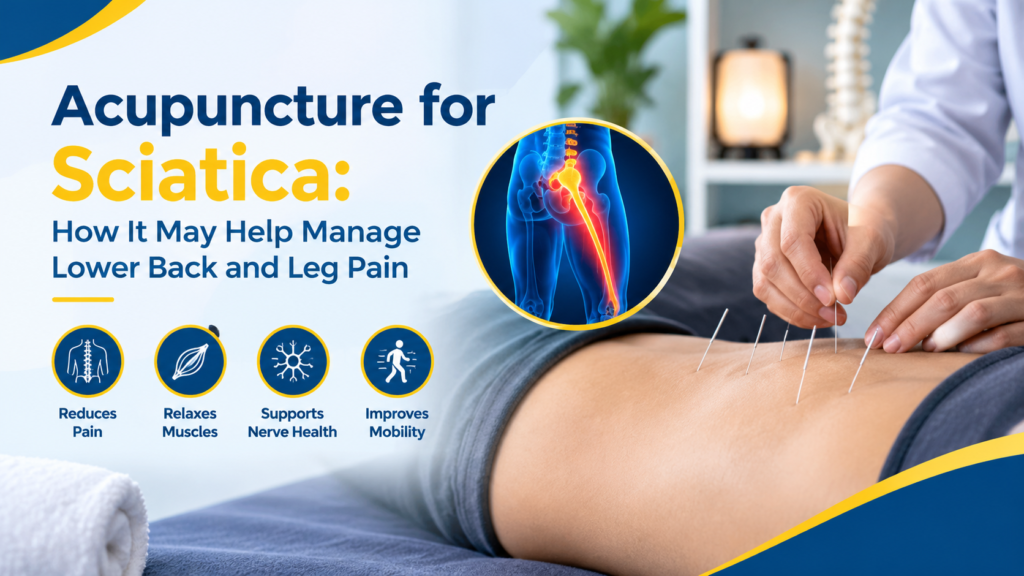
Sciatica can make an ordinary day feel unexpectedly difficult.
Pain may begin in the lower back or buttock and travel down the leg. Sitting can become uncomfortable. Standing up may trigger a sharp sensation. Some people experience burning, tingling, numbness, or weakness along with the pain.
If conventional self-care has not provided enough relief, you may start researching acupuncture for sciatica.
Can acupuncture actually help?
Current research suggests that acupuncture may reduce pain and improve function for some people with sciatica, particularly chronic sciatica related to lumbar disc herniation. However, the evidence is still developing, research quality varies, and clinical guidelines do not all agree about recommending it specifically for sciatica.
That makes acupuncture better viewed as a potential pain-management option within an appropriate treatment plan, not as a guaranteed cure or a replacement for diagnosing the reason your sciatic symptoms are occurring.
The first step is understanding what sciatica actually is.
Key Takeaways
- Sciatica describes pain and other symptoms associated with irritation or compression of nerve roots that contribute to the sciatic nerve.
- Pain commonly travels from the lower back or buttock into one leg.
- A herniated lumbar disc is a common cause, but spinal stenosis and other conditions can produce similar symptoms.
- Acupuncture may help some people manage sciatic pain and improve function.
- A 2024 randomized clinical trial found better pain and function outcomes with acupuncture than sham acupuncture in adults with chronic sciatica caused by herniated discs.
- Recent systematic reviews are encouraging, but researchers continue to identify limitations in the quality and consistency of the evidence.
- Clinical guidelines disagree. NICE currently advises against acupuncture for low-back pain with or without sciatica, while U.S. guidance is more supportive of acupuncture for some types of pain, including low-back pain.
- Acupuncture does not mechanically move a herniated disc back into place or guarantee removal of nerve compression.
- There is no single set of “sciatica acupuncture points” appropriate for every patient.
- Progressive weakness, bladder or bowel problems, saddle-area numbness, or severe symptoms affecting both legs require urgent medical evaluation rather than an acupuncture appointment.
What Is Sciatica?
Sciatica is not simply another name for lower-back pain.
It describes a pattern of symptoms involving the sciatic nerve or, more commonly, the nerve roots that eventually form it.
The sciatic nerve is the body’s largest nerve.
It begins from nerve roots in the lower spine and travels through the buttock and down the leg.
When those nerve roots become irritated or compressed, symptoms can appear along that pathway.
Common symptoms include:
- Lower-back pain
- Buttock pain
- Pain traveling down one leg
- Burning
- Tingling
- Pins-and-needles sensations
- Numbness
- Leg weakness
Some people have substantial leg pain with relatively little back pain.
Others experience both.
What Does Sciatic Nerve Pain Feel Like?
Sciatica does not feel identical for everyone.
Someone may describe it as:
“An electric shock running from my hip to my calf.”
Another person may say:
“My leg burns whenever I sit too long.”
Others experience:
- Deep aching
- Sharp shooting pain
- Tingling into the foot
- Numbness in part of the leg
- Pain aggravated by coughing or sneezing
- Symptoms worsened by prolonged sitting
The location can also vary according to which nerve root is involved.
That variation is one reason a treatment plan should start with an individual assessment rather than assuming every case of leg pain is the same.
What Causes Sciatica?
Sciatica can have several underlying causes.
Herniated Disc
The discs between the vertebrae provide cushioning.
When disc material protrudes or herniates, it can irritate or compress a nearby nerve root.
Lumbar disc herniation is one of the most common explanations for true sciatica.
Spinal Stenosis
Narrowing within the spinal canal or nerve passageways can place pressure on nerve structures.
This becomes more common with age.
Degenerative Changes
Age-related changes involving discs, joints, and surrounding spinal structures can reduce the space available to nerves.
Spondylolisthesis
One vertebra can shift relative to another and potentially narrow the space around a nerve root.
Other Conditions
Less common causes can include:
- Trauma
- Tumors
- Infection
- Other neurological or spinal conditions
This is why persistent sciatica should not automatically be treated as a muscle problem.
Is Piriformis Syndrome the Same as Sciatica?
Not exactly.
Piriformis-related pain can resemble sciatica because the piriformis muscle is located near the sciatic nerve in the buttock.
But classic lumbar radiculopathy begins with irritation of a spinal nerve root.
Pain coming from the buttock region for another reason is not necessarily the same condition.
Determining the likely source matters because:
similar symptoms do not always require identical treatment.
Does Acupuncture Help Sciatica?
Research increasingly suggests that it may help some patients, especially people with chronic sciatica related to lumbar disc herniation.
One of the stronger recent studies was a 2024 randomized clinical trial published in JAMA Internal Medicine.
Researchers studied adults with chronic sciatica caused by a herniated lumbar disc.
Participants received either:
- Acupuncture
- Sham acupuncture
The acupuncture group received 10 treatment sessions over four weeks.
At four weeks, the acupuncture group reported greater reductions in leg pain and greater improvement in disability than the sham group.
Differences emerged by the second week and persisted during follow-up through 52 weeks.
That is encouraging.
But it does not mean ten treatments will produce the same result for every person with sciatica.
The trial studied a specific group:
people with chronic sciatica from herniated discs.
Results should not automatically be generalized to every type of back or leg pain.
What Do Broader Reviews Say About Acupuncture for Sciatica?
The broader research picture is promising but less certain than a simple headline might suggest.
A 2025 overview of systematic reviews and meta-analyses found that acupuncture appeared to reduce pain and improve treatment outcomes for sciatica.
However, the authors also identified significant weaknesses in the underlying evidence, including:
- Methodological problems
- Risk of bias
- Publication bias
- Inconsistent reporting
Their conclusion was essentially:
The treatment looks promising, but better research is still needed.
A 2026 systematic review focused on chronic sciatica from herniated discs also reported improvements in leg pain and function.
That analysis included 11 randomized trials with 868 participants.
Most participants came from studies conducted in China, and the authors again emphasized methodological limitations.
Taken together, the evidence supports discussing acupuncture as an option.
It does not justify promising that acupuncture will cure sciatica.
Why Do Clinical Guidelines Disagree About Acupuncture for Sciatica?
This is important because online articles often mention only evidence that supports the treatment being promoted.
Clinical guidance is not completely consistent.
The UK’s NICE guideline for low-back pain and sciatica currently recommends not offering acupuncture for low-back pain with or without sciatica.
That recommendation dates from the guideline’s earlier evidence review.
Since then, newer research has emerged, including the 2024 randomized trial specifically studying chronic disc-related sciatica.
In the United States, the National Center for Complementary and Integrative Health discusses evidence for acupuncture across several pain conditions, including low-back pain, although evidence specifically for sciatica is a narrower question.
So the current picture is not:
“Science has proven acupuncture cures sciatica.”
Nor is it:
“There is no evidence acupuncture can help.”
A fairer conclusion is:
Newer research suggests potential benefit, particularly for chronic disc-related sciatica, but evidence quality and guideline recommendations remain mixed.
How Might Acupuncture Help With Sciatic Nerve Pain?
Researchers do not completely understand every mechanism responsible for acupuncture’s effects.
The NCCIH notes that acupuncture may affect:
- Nervous-system activity
- Local tissues
- Pain processing
- Nonspecific treatment effects
In practical terms, the goal of acupuncture for someone with sciatica is generally symptom management.
That may include trying to reduce:
- Leg pain
- Lower-back pain
- Muscle tension
- Pain-related limitations
and support improved movement and daily function.
It is more accurate to talk about pain modulation and functional improvement than to claim that a needle physically “unpinches” the sciatic nerve.
Can Acupuncture Fix a Pinched Sciatic Nerve?
The phrase “pinched sciatic nerve” is commonly used, but it can oversimplify what is happening.
For example, a person may have nerve-root irritation caused by a lumbar disc herniation.
Acupuncture does not physically push that disc back into place.
Likewise, acupuncture cannot directly reverse:
- Severe spinal stenosis
- A major structural lesion
- A tumor
- Significant spinal instability
What acupuncture may do is help manage pain and related symptoms while the underlying condition is being appropriately monitored or treated.
That is why diagnosis matters.
Pain relief and structural correction are not necessarily the same thing.
Can Acupuncture Reduce Lower-Back and Leg Pain Together?
Potentially.
Sciatica frequently involves both areas.
A person may experience:
lower back → buttock → thigh → calf
pain along one continuous pathway.
In the 2024 JAMA trial, researchers found improvement not only in leg pain and disability but also in secondary measures that included back pain.
That makes acupuncture for lower back and leg pain a reasonable treatment topic to discuss with a qualified practitioner when the symptoms fit sciatica.
Again, the goal is symptom management rather than guaranteeing correction of the underlying spinal condition.
What Acupuncture Points Are Used for Sciatica?
There is no universal list that every patient receives.
This is one of the biggest misconceptions created by online “acupuncture point charts.”
A licensed acupuncturist may choose points based on:
- Where the pain travels
- Whether back pain is present
- Which movements aggravate symptoms
- Whether numbness or tingling occurs
- Muscle tension
- Overall health history
- Traditional Chinese medicine assessment
- The practitioner’s clinical approach
Points may be selected locally around the:
- Lower back
- Hip
- Buttock
and at more distant locations elsewhere along the body.
Some practitioners may also use electroacupuncture.
The appropriate point selection, depth, angle, and technique should be determined by a trained practitioner.
Should You Try Acupuncture Points for Sciatica Yourself?
Needling should not be treated like a home-pressure-point experiment.
Acupuncture needles penetrate the skin.
Incorrect needling can cause injury.
If you want to try acupuncture, use a properly trained and licensed practitioner rather than attempting to reproduce a treatment from a diagram, video, or social media post.
Acupressure and gentle self-massage are different from inserting acupuncture needles.
What Is Electroacupuncture for Sciatica?
Electroacupuncture begins with acupuncture needles placed by the practitioner.
A controlled electrical current is then applied between selected needles.
Researchers have studied electroacupuncture for a range of pain conditions.
Some sciatica studies include it among the acupuncture approaches being evaluated.
Whether it is appropriate depends on the patient’s health history and treatment plan.
It is not automatically necessary for everyone with sciatic pain.
What Does Traditional Chinese Medicine Say About Sciatica?
Traditional Chinese medicine approaches symptoms differently from conventional biomedical diagnosis.
Rather than treating every patient with the same fixed protocol, an acupuncturist may evaluate the person’s broader symptom pattern before choosing points.
Treatment can involve:
- Acupuncture
- Moxibustion
- Cupping
- Chinese herbal approaches
- Lifestyle recommendations
depending on the practitioner’s scope and the patient’s needs.
That traditional framework can coexist with modern medical evaluation.
Someone can have a conventional diagnosis such as lumbar disc herniation while also receiving acupuncture as part of a broader pain-management plan.
One approach should not require ignoring important medical findings from the other.
What Happens During an Acupuncture Appointment for Sciatica?
The first session should involve more than immediately inserting needles.
Health History
The practitioner may ask:
- Where does the pain begin?
- Where does it travel?
- When did it start?
- What makes it worse?
- What makes it better?
- Do you have numbness?
- Do you have weakness?
- Have you had imaging?
- Have you been diagnosed with a disc problem?
- What treatments have you already tried?
Physical and Symptom Assessment
Your practitioner may consider your:
- Pain pattern
- Movement
- Tender areas
- Muscle tension
- Functional limitations
Treatment
Needles are placed at selected points based on the treatment approach.
Acupuncture needles are extremely thin.
Some people feel almost nothing during insertion.
Others notice:
- Pressure
- Heaviness
- Tingling
- Dull aching
- Temporary tenderness
The exact experience varies.
How Long Does an Acupuncture Treatment Take?
Appointment length varies according to the practice and treatment plan.
Needles commonly remain in place for a period while the patient rests.
Your first visit may take longer because the practitioner needs to understand your symptoms and health history.
Two people with pain traveling down the leg can have different causes, severity, histories, and functional limitations, so treatment should not automatically be approached as one fixed protocol.
How Many Acupuncture Sessions Do You Need for Sciatica?
There is no scientifically established number that guarantees success.
The answer depends on:
- How long symptoms have been present
- Severity
- Underlying cause
- Response to treatment
- Overall health
- Treatment goals
The 2024 JAMA trial used:
10 acupuncture sessions over four weeks.
That is useful research information.
It should not be turned into:
“Everyone needs exactly ten sessions.”
Clinical care is more individualized.
A practitioner may recommend a treatment schedule and then adjust it based on whether meaningful improvement is occurring.
How Quickly Can Acupuncture Help Sciatica?
Some people report changes relatively early.
Others require several sessions.
Some do not respond meaningfully.
In the JAMA chronic-sciatica trial, differences between acupuncture and sham treatment began appearing around week two.
But research averages cannot predict one individual’s response.
A useful treatment plan should include periodic reassessment.
✔ Is leg pain decreasing?
✔ Can I sit longer?
✔ Is walking easier?
✔ Am I sleeping better?
✔ Is numbness changing?
✔ Is function improving?
✔ Do I still need the same treatment frequency?
Treatment should be judged by outcomes, not simply by the number of appointments completed.
Can Acupuncture Make Sciatica Worse?
Temporary soreness, minor bleeding, or bruising can occur after acupuncture.
In the 2024 sciatica trial, acupuncture-related adverse events were mild and self-limiting. Minor bleeding and bleeding under the skin were among the most common.
The NCCIH’s acupuncture safety guidance states that relatively few complications have been reported when acupuncture is performed appropriately.
Serious complications are uncommon but can occur with improper technique, including:
- Infection
- Organ puncture
- Nervous-system injury
The same NCCIH safety guidance notes that the FDA regulates acupuncture needles as medical devices and requires them to be sterile and labeled for single use.
Choose a properly trained professional.
Who Should Talk With a Healthcare Provider Before Acupuncture?
Make sure your practitioner knows about:
- Blood-thinning medication
- Bleeding disorders
- Pregnancy
- Pacemaker or implanted electrical devices, particularly if electroacupuncture is being considered
- Significant medical conditions
- Recent surgery
- Infection
- Cancer
- Neurological problems
Also provide an accurate list of medications and supplements.
Complementary treatment is safest when everyone involved in your care has the relevant information.
When Sciatica Should Be Medically Evaluated Before Acupuncture
Not every person with radiating leg pain should immediately book acupuncture without evaluation.
Consider medical assessment when symptoms are:
- Severe
- New and unexplained
- Getting progressively worse
- Associated with significant numbness
- Associated with weakness
- Persistent despite self-care
- Following significant trauma
- Associated with fever or unexplained illness
This helps determine whether the pain really is sciatica and whether a cause requiring other treatment needs attention.
What Sciatica Symptoms Require Urgent Medical Care?
Certain symptoms can signal serious nerve compression.
Seek urgent emergency medical evaluation if you develop symptoms such as:
✔ Severe or worsening weakness in both legs
✔ Sciatica affecting both sides
✔ Numbness around the genitals, buttocks, or saddle area
✔ New difficulty starting urination
✔ Inability to urinate
✔ New loss of bladder control
✔ New loss of bowel control
These can be warning signs of cauda equina syndrome, a rare but serious condition requiring urgent hospital assessment.
Do not schedule acupuncture first and wait to see whether it improves.
Emergency neurological symptoms require medical care.
Can Acupuncture Replace Physical Therapy for Sciatica?
Not necessarily.
Physical therapy and acupuncture do different things.
A physical therapy plan may focus on:
- Movement
- Strength
- Mobility
- Activity modification
- Exercise
- Functional rehabilitation
Acupuncture is primarily being considered here as a complementary pain-management approach.
Some people may use both within a coordinated treatment plan.
Acupuncture Is My Life lists both acupuncture and physical therapy among the treatments available on its main services page.
The best combination depends on the diagnosis and individual needs.
Can You Exercise While Getting Acupuncture for Sciatica?
In many cases, appropriate movement remains an important part of managing sciatica.
Prolonged complete bed rest is generally not the goal for uncomplicated sciatica.
What you can safely do depends on:
- Pain severity
- Weakness
- Underlying cause
- Medical advice
- Previous activity level
A clinician or physical therapist can help determine suitable exercises.
Do not force stretches through severe radiating pain simply because stretching is often recommended online.
What About Stretching for Sciatica?
Gentle movement can be helpful for some people.
But there is no single “sciatica stretch” that is ideal for every underlying cause.
A movement that helps one person may worsen another person’s symptoms.
If stretching causes:
- Increasing leg pain
- New numbness
- Weakness
- More intense symptoms farther down the leg
stop and discuss the response with an appropriate clinician.
The goal is not to prove how far you can stretch.
It is to support safe movement and function.
Can Acupuncture Be Combined With Other Sciatica Treatments?
Yes, depending on your medical situation.
Sciatica management can involve combinations of:
- Staying appropriately active
- Physical therapy
- Exercise
- Medication when appropriate
- Acupuncture
- Other conservative treatments
- Injections in selected cases
- Surgical evaluation when indicated
A multimodal plan can make sense because sciatica affects both pain and function.
Acupuncture does not need to be framed as a choice between:
“natural treatment”
and
“medical treatment.”
It can be considered alongside medical care when appropriate.
When Might Someone Consider Acupuncture for Sciatica?
Acupuncture may be worth discussing when:
✔ Sciatic-type pain has been medically assessed.
✔ You are looking for a non-drug pain-management option.
✔ Symptoms have become persistent.
✔ Pain is interfering with sleep or activity.
✔ You want to explore complementary treatment alongside rehabilitation.
✔ There are no urgent neurological warning signs.
✔ Your healthcare providers consider acupuncture reasonable for your situation.
If you are considering this route, you can review Acupuncture Is My Life’s acupuncture and other pain-focused treatment services before discussing whether acupuncture fits your symptoms and broader treatment plan.
That is more useful than selecting a generic collection of “sciatica points” from the internet.
When Might Acupuncture Not Be Enough?
Pain relief can be valuable.
But symptom relief should not hide a condition that requires additional evaluation.
Acupuncture alone may not be enough when someone has:
- Progressive neurological weakness
- Significant structural compression
- Severe spinal stenosis
- Repeated worsening despite conservative care
- Major functional loss
- Red-flag symptoms
- A condition requiring surgical evaluation
For example, if leg pain improves but muscle weakness continues to worsen, that is not a reason to simply continue pain treatment indefinitely.
Function and neurological status matter too.
How Do You Know Whether Acupuncture Is Helping?
Do not judge progress only by asking:
“Does my back hurt today?”
Track functional changes.
Pain
Is the intensity lower?
Radiation
Does the pain travel as far down the leg?
Sitting
Can you sit longer before symptoms begin?
Walking
Can you walk farther or more comfortably?
Sleep
Are symptoms waking you less often?
Medication Use
Has your need for symptom-relief medication changed under appropriate medical guidance?
Daily Function
Can you perform more normal activities?
Those measurements make treatment progress easier to evaluate.
Should You Continue Acupuncture if Nothing Is Changing?
Treatment should have a purpose.
If several sessions produce no meaningful change, discuss that openly with the practitioner.
Questions worth asking include:
- Are we treating the correct problem?
- Should the treatment approach change?
- Should I be medically reassessed?
- Would physical therapy be useful?
- Are worsening symptoms suggesting another diagnosis?
- What outcome should we expect before continuing further?
Continuing indefinitely simply because acupuncture is considered complementary care is not a useful treatment strategy.
Acupuncture for Sciatica: What It Can and Cannot Do
| Acupuncture May Help With | Acupuncture Should Not Be Promised to Do |
| Managing sciatic pain | Cure every case of sciatica |
| Reducing lower-back or leg discomfort for some patients | Physically push a herniated disc into place |
| Supporting function | Reverse severe structural nerve compression |
| Providing a non-drug pain-management option | Replace urgent neurological evaluation |
| Complementing physical therapy or other care | Guarantee avoidance of surgery |
| Supporting an individualized pain plan | Work identically for every person |
Setting realistic expectations is part of good treatment.
Do This, Not That When Considering Acupuncture for Sciatica
| Do This | Not That |
| Find out whether your symptoms actually fit sciatica | Assume every buttock or leg pain is sciatic nerve pain |
| Tell the practitioner about numbness and weakness | Focus only on pain intensity |
| Choose a licensed practitioner | Needle yourself from an online point chart |
| Track pain and function | Count sessions without measuring outcomes |
| Use acupuncture as part of appropriate care | Assume it repairs every structural cause |
| Seek urgent care for neurological red flags | Wait for acupuncture to fix bladder, bowel, or progressive weakness symptoms |
| Reassess treatment if nothing changes | Continue indefinitely without reviewing progress |
Acupuncture Can Be One Part of a Thoughtful Sciatica Treatment Plan
So, does acupuncture for sciatica work?
The evidence is becoming more encouraging.
A well-designed randomized trial found meaningful improvements in pain and function among people with chronic sciatica caused by lumbar disc herniation.
More recent evidence reviews also suggest potential benefit.
At the same time, research limitations remain, and major clinical guidelines do not completely agree about whether acupuncture should routinely be recommended specifically for sciatica.
That makes the most responsible conclusion straightforward:
Acupuncture may be a reasonable pain-management option for some people, but it should be matched to the individual rather than sold as a universal cure.
Start by understanding why your leg hurts.
Pay attention to numbness and weakness, not only pain.
Do not ignore emergency neurological symptoms.
And if acupuncture is appropriate for your situation, look for professional assessment rather than a one-size-fits-all list of points.
Acupuncture Is My Life lists acupuncture among its services for people seeking support with chronic or acute pain and injury recovery. You can review the practice’s current acupuncture and related treatment options on its main Services page.
For someone dealing with persistent lower-back and leg pain, that conversation can help answer a more useful question than:
“Does acupuncture work for everybody with sciatica?”
The better question is:
“Does acupuncture make sense for my type of symptoms, my diagnosis, and the rest of my treatment plan?”
Frequently Asked Questions
Does Acupuncture Help Sciatica?
It may help some people. A 2024 randomized trial found that adults with chronic sciatica caused by herniated discs experienced less leg pain and better function after acupuncture compared with sham treatment. Broader reviews are also encouraging, although evidence quality varies and clinical guidelines do not all recommend acupuncture specifically for sciatica.
How Many Acupuncture Sessions Are Needed for Sciatica?
There is no universal number. The 2024 JAMA trial used 10 treatments over four weeks, but a real-world treatment schedule should depend on the cause, severity, duration of symptoms, and individual response.
Where Are Acupuncture Needles Placed for Sciatica?
There is no single standard point combination for every patient. A licensed acupuncturist may select points around the lower back, buttock, hip, or elsewhere on the body based on the symptoms and treatment approach.
Can Acupuncture Help a Pinched Sciatic Nerve?
Acupuncture may help manage pain associated with nerve-root irritation or compression, but it does not mechanically remove every structural cause of nerve compression. Significant weakness or severe structural problems may require additional medical treatment.
How Quickly Does Acupuncture Work for Sciatica?
Response varies. In one recent clinical trial, differences between acupuncture and sham treatment became apparent around the second week. Some people may notice changes earlier, later, or not at all.
Is Acupuncture Good for Lower-Back Pain and Sciatica?
Evidence supports acupuncture as a possible treatment for some forms of low-back pain, and newer studies suggest potential benefit for chronic sciatica. However, evidence specific to sciatica remains less established and guideline recommendations differ.
Can Acupuncture Permanently Cure Sciatica?
A permanent cure should not be promised. Sciatica has different underlying causes. Acupuncture may help manage symptoms, but whether symptoms resolve permanently depends partly on the cause and natural course of the condition.
Is Acupuncture Safe for Sciatica?
Acupuncture is generally considered safe when performed by a qualified practitioner using sterile, single-use needles. Minor bruising, soreness, or bleeding can occur. Serious complications are uncommon but possible when acupuncture is performed improperly.
Should I See a Doctor or an Acupuncturist for Sciatica?
That depends on the situation. New, severe, persistent, or worsening neurological symptoms deserve medical assessment. Acupuncture can then be considered as part of an appropriate treatment plan when there are no urgent warning signs.